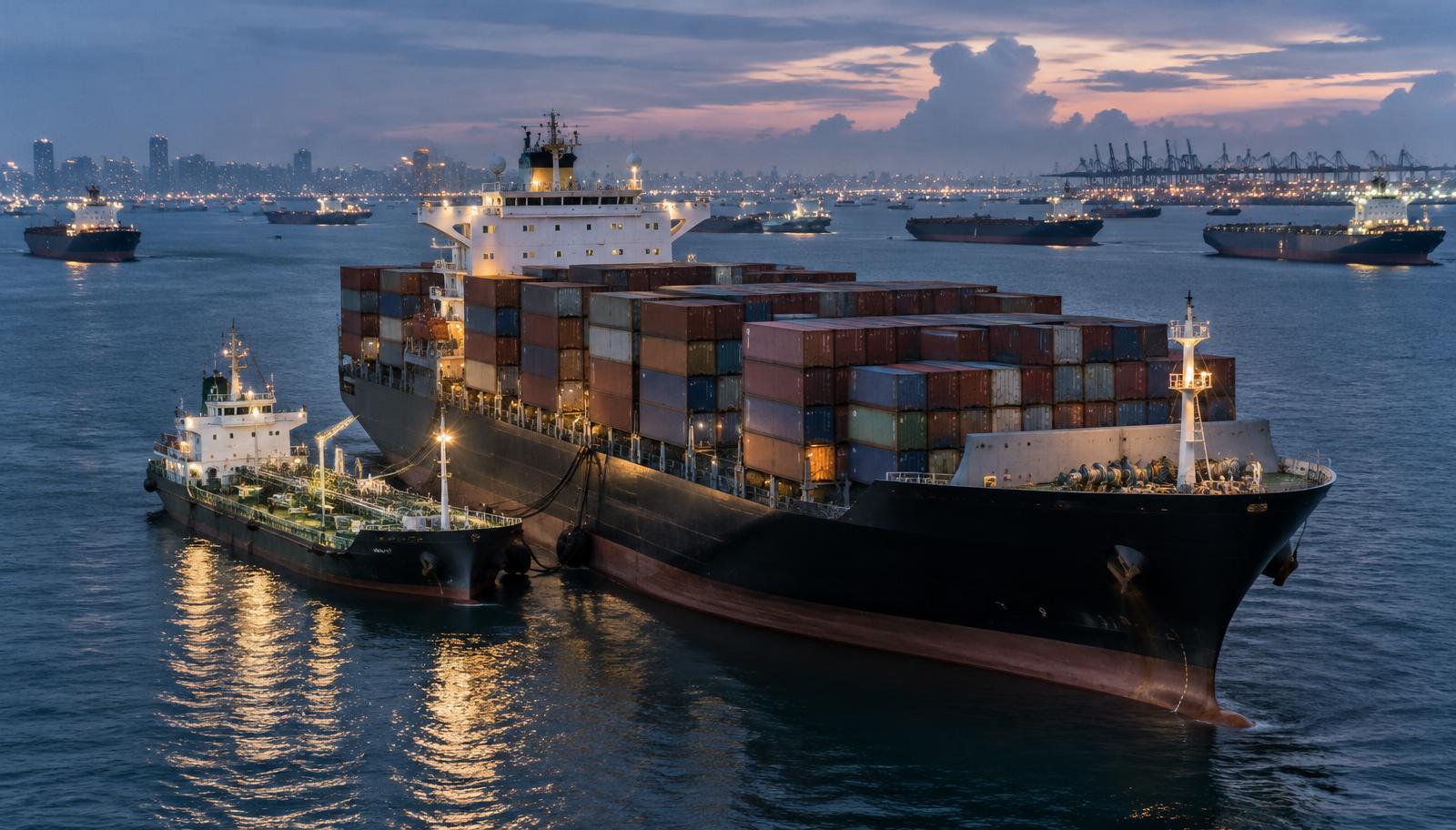
Cover image: AI-generated illustration created for BunkerWatch. It does not show a real vessel or operation.
The Singapore bunker market is entering October under noticeably tighter conditions, with rising marine fuel prices, constrained prompt availability and reduced regional product flows creating a more difficult purchasing environment for shipowners and operators.
The move is particularly important because Singapore remains the world's largest bunkering hub. Changes there rarely stay isolated for long. Tightness in Singapore can quickly influence procurement decisions across Fujairah, Zhoushan and other major Asian bunker ports while altering the economics of where vessels choose to stem fuel.
For operators planning voyages through Asia, the current market is another reminder that bunker procurement is becoming increasingly dependent on regional supply conditions rather than simply the direction of crude oil.
Singapore Prices Move Sharply Higher
Singapore bunker prices moved higher during the first week of October.
According to ENGINE, Singapore VLSFO reached approximately $904 per metric tonne on October 7, after increasing about $44/mt in a single session. LSMGO was assessed around $1,296/mt, while HSFO reached approximately $790/mt.
The magnitude of the move is significant.
Singapore's average VLSFO price increased from roughly $744/mt in July to $865/mt in September, according to ENGINE, with the early-October average running even higher.
That represents a dramatic shift from the significantly weaker bunker environment seen one year earlier.
For a vessel lifting several thousand tonnes of fuel, relatively modest changes in bunker prices can quickly translate into hundreds of thousands of dollars in additional voyage costs.
The volatility therefore matters well beyond the bunker desk.
It directly affects voyage economics, chartering calculations, speed decisions and the relative attractiveness of alternative bunkering ports.
Supply Is Becoming Part of the Story
The price increase is not simply a crude oil story.
Singapore entered October facing tighter availability for both VLSFO and HSFO, according to market reports.
S&P Global Commodity Insights reported at the end of September that Singapore was expected to receive approximately 1.5 million to 1.6 million metric tonnes of low-sulfur fuel oil from Western markets during October, compared with roughly 1.6 million to 1.8 million tonnes in September.
Higher freight costs have made some arbitrage movements into Asia less economical, reducing the incentive to move cargoes eastward.
Market participants cited particularly tight conditions during the first half of October, although additional Western cargoes could arrive later in the month.
This is an important distinction for bunker buyers.
A global fuel market can appear adequately supplied while individual bunker hubs become temporarily tight because the economics of physically moving product into those locations no longer work.
Bunker prices ultimately reflect fuel that is available at the port, at the right time and in the required quantity.
That can create substantial regional dislocations.
China Adds Another Layer of Uncertainty
Regional refined-product supply has also been disrupted by China's decision to sharply restrict fuel exports during October.
Reuters reported that China suspended fuel exports beyond Hong Kong and Macau for the month, tightening product availability across parts of Asia.
The immediate effects are broader than marine fuel alone, affecting gasoline, diesel, gasoil and other refined products.
But bunker markets do not operate independently from the wider refining system.
Marine fuels compete within the same refinery economics, storage infrastructure, blending systems, cargo markets and regional logistics networks.
When middle-distillate or other refined-product margins become exceptionally strong, refiners have powerful incentives to maximize production of higher-value products.
That can indirectly affect bunker component availability and pricing.
The result is a market where bunker buyers increasingly need to monitor not only crude oil prices but also refinery economics, product inventories, freight rates and regional arbitrage flows.
The Scrubber Equation Remains Important
The current market also reinforces the continuing commercial importance of exhaust gas cleaning systems.
Under IMO 2020 regulations, vessels operating outside designated Emission Control Areas generally must burn fuel containing no more than 0.50% sulfur.
Ships equipped with approved exhaust gas cleaning systems — commonly known as scrubbers — can continue consuming high-sulfur fuel oil while maintaining equivalent emissions compliance.
That creates an important commercial relationship between the price of VLSFO and HSFO.
The larger the premium for compliant low-sulfur fuel over HSFO, the greater the potential operating advantage for a scrubber-equipped vessel.
The calculation is not static.
It changes by port, vessel consumption, voyage length, maintenance costs and the availability of individual fuel grades.
In Rotterdam, for example, ENGINE reported on October 8 that diverging movements in VLSFO and HSFO had widened the port's Hi5 spread — the difference between the two grades — to approximately $70/mt.
For high-consumption vessels, especially large tankers and bulk carriers, even a $50-$100/mt differential can become commercially meaningful over a long voyage.
Geography Matters More Than the Headline Oil Price
One of the clearest lessons from the current market is that there is no single global bunker price.
A vessel's actual fuel cost depends on where it bunkers.
Singapore, Fujairah, Rotterdam, Zhoushan, Gibraltar, Houston and other major ports can trade at substantial premiums or discounts to one another depending on local inventories and supply conditions.
On October 7, ENGINE assessed Singapore VLSFO roughly $82/mt below Fujairah and approximately $23/mt below Zhoushan.
Those spreads can change rapidly.
For operators with flexibility in their voyage planning, the decision to bunker at one location instead of another can therefore materially affect voyage profitability.
The relevant calculation is not simply:
Where is fuel cheapest?
It is:
Where is fuel cheapest after accounting for deviation, additional steaming, port costs, quantity requirements, delivery timing and operational risk?
That is a much more complicated question.
What Shipowners and Operators Should Watch
The next several weeks will provide a clearer indication of whether Singapore's current tightness is temporary or develops into a more persistent regional imbalance.
Several factors deserve particular attention.
Western LSFO cargo arrivals into Singapore will be critical. If arbitrage flows increase during the second half of October as expected, some of the immediate supply pressure could ease.
China's refined-product export policy will also matter. Extended restrictions could keep Asian product markets tighter than they would otherwise be.
Crude oil remains important, but refinery margins and product cracks may increasingly determine how changes in crude translate into actual marine fuel prices.
Availability should also be watched alongside outright price.
A port showing an attractive headline bunker price may offer little advantage if prompt stems are unavailable or suppliers require extended lead times.
For charterers and owners operating large vessels, regional bunker spreads should increasingly be treated as part of voyage optimization rather than as a procurement decision made after the voyage has already been fixed.
The Bigger Picture
Bunker markets are becoming more complicated, not less.
Shipowners must simultaneously evaluate crude prices, refined-product supply, regional arbitrage flows, sulfur spreads, carbon regulations, alternative fuels and increasingly fragmented geopolitical trade patterns.
Singapore's current market illustrates how quickly those forces can converge.
The world's largest bunkering hub remains exceptionally liquid and strategically important. Singapore handled a record 56.77 million tonnes of bunker sales in 2025, according to the Maritime and Port Authority of Singapore, and volumes exceeded 28 million tonnes during the first half of 2026.
But enormous scale does not eliminate volatility.
When cargo flows tighten, freight economics change or regional refining conditions shift, even the world's deepest bunker market can move quickly.
For shipowners, charterers and bunker buyers, the takeaway is simple:
The bunker market is no longer something that can be evaluated solely through the price of oil. Location, availability and product flows increasingly matter just as much as the headline barrel.
Sources
Maritime and Port Authority of Singapore — APPEC 2026 Shipping and Bunker Conference
Singapore bunker sales and 2026 market statistics.
https://www.mpa.gov.sg/media-centre/details/keynote-speech-by-dce-ops-tech-at-appec-2026-shipping-and-bunker-conference-10-september-2026
S&P Global Commodity Insights — Singapore Low-Sulfur Marine Fuel Arbitrage Arrivals Could Decline in October
September 30, 2026.
https://www.spglobal.com/energy/en/news-research/latest-news/refined-products/093026-singapore-low-sulfur-marine-fuel-arbitrage-arrivals-from-west-could-decline-in-oct
ENGINE — East of Suez Market Update
October 7, 2026. Singapore VLSFO, LSMGO and HSFO pricing and availability.
https://www.engine.online/news/east-of-suez-market-update-7-oct-825d
ENGINE — Europe & Africa Market Update
October 8, 2026. Rotterdam bunker pricing and Hi5 spread.
https://www.engine.online/news/europe-and-africa-market-update-8-oct-8273
Reuters — China Fuel Export Suspension to Choke Supplies in Asia
October 2, 2026. Regional refined-product supply and export restrictions.
https://www.reuters.com/business/energy/china-fuel-export-suspension-choke-supplies-asia-2026-10-02/
International Maritime Organization — IMO 2020 Sulphur Regulations
Background on the global sulfur limit and exhaust gas cleaning systems.
https://www.imo.org/en/mediacentre/hottopics/pages/sulphur-2020.aspx
Bunker Watch Market Intelligence provides independent market commentary for informational purposes only. Pricing and availability can change rapidly and should be independently verified before commercial decisions are made.
Explore the data on BunkerWatch → Track bunker prices, compare ports, follow the market, or browse the Intel Blog.