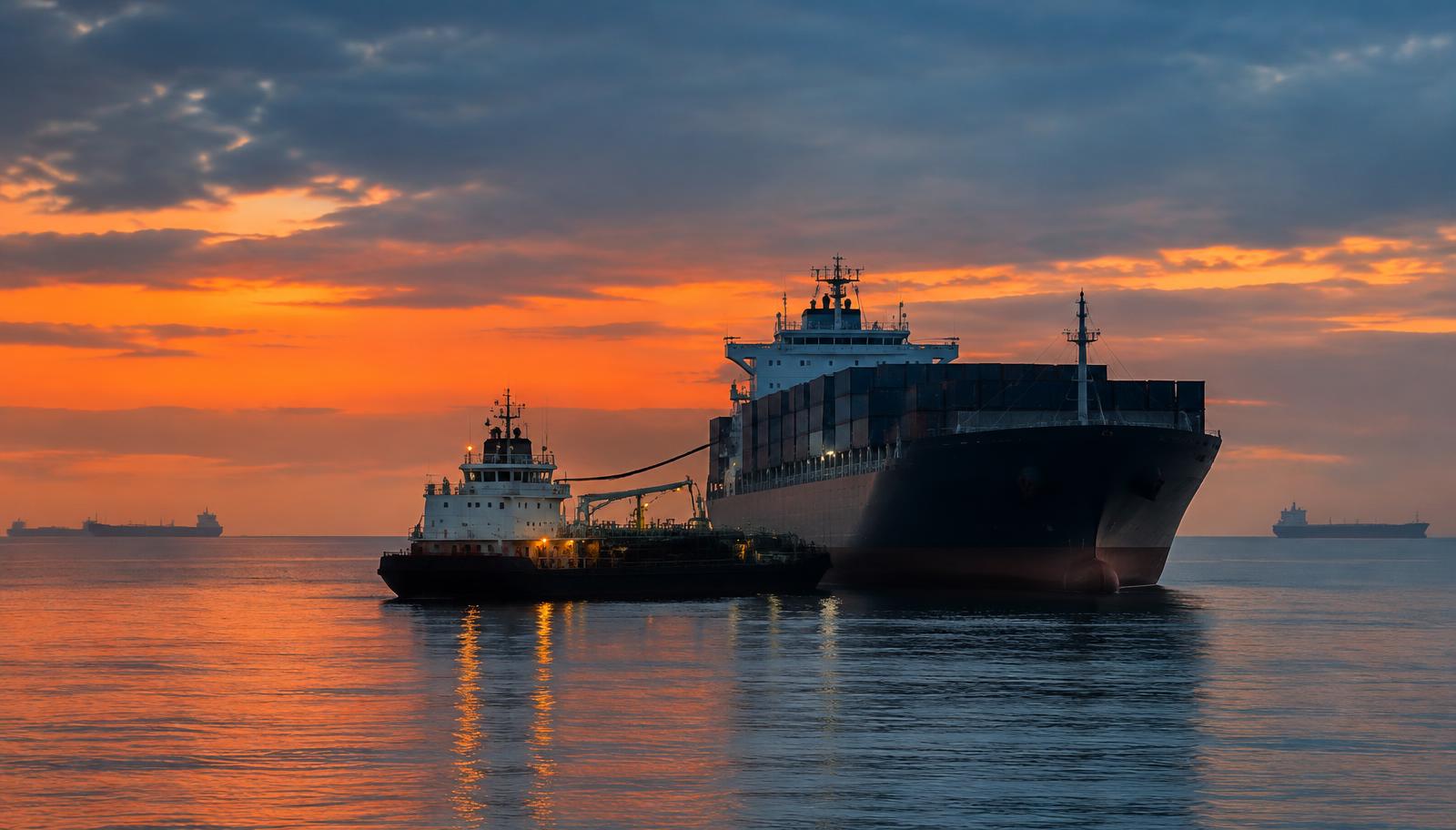
Cover image: AI-generated illustration created for BunkerWatch. It does not show a real vessel or operation.
Crude oil has fallen sharply after the U.S. midterm elections, but the Strait of Hormuz remains dangerous and distillate supply is tight. For bunker buyers, the drop in futures is not yet the relief it looks like.
Crude Falls, but the Physical Market Hasn't Caught Up
Oil futures fell hard this week. Brent dropped about 9% on Wednesday, November 4, and was trading near $94 per barrel on Thursday as markets reacted to the Democratic sweep of Congress and to hopes that a new political balance in Washington could open the door to talks with Iran.
Bunker prices usually follow crude with a lag, and this time the gap may be wider than normal. The latest BunkerWatch port data, collected in late October before the sell-off, showed marine fuel still priced near its highs:
| Port | VLSFO ($/mt) | HSFO ($/mt) | MGO ($/mt) |
|---|---|---|---|
| Fujairah | 981 | 752 | 1,769 |
| Singapore | 963 | 894 | 1,352 |
| Houston | 817 | 602 | 1,421 |
| Rotterdam | 766 | 697 | 1,446 |
Indicative assessments from BunkerWatch, late October 2026. Check live prices for the latest figures.
Fujairah VLSFO was trading more than $200/mt above Rotterdam, and Fujairah MGO was over $300/mt above both Rotterdam and Houston. Those spreads reflect risk and supply, not crude costs, and a falling Brent price does little to close them.
Hormuz Is Still the Deciding Factor
The headlines from the Gulf this week were mixed at best. Iran's parliament announced it would exempt China, India and several other trading partners from its transit restrictions in the Strait of Hormuz, while the U.S. blockade continues. At the same time, the IRGC reported that two tankers and a tugboat caught fire in the Strait on Thursday, a day after it said four tankers were destroyed by mines south of the waterway.
A selective reopening is not a normal reopening. Vessels outside the exempted flags still face high war-risk premiums, long detours or both. That keeps pressure on Gulf bunkering hubs, and on Fujairah in particular, even as futures fall.
The longer-term response is already visible. The UAE is reportedly weighing a third crude export pipeline that would bypass Hormuz, and LNG buyers are shifting toward Africa and the United States. These moves point to a market preparing for a long disruption, not a quick fix.
Distillates Remain the Tight Spot
The squeeze on marine gasoil is likely to last longer than the squeeze on fuel oil. The U.S. Energy Information Administration reported this week that refiners have shifted output away from gasoline toward middle distillates, driven by unusually high margins for diesel and jet fuel through 2026.
Meanwhile, China's diesel exports are expected to fall in November after strong shipments in August and September drew down domestic inventories. Less Chinese export volume means less product flowing into Asian trading hubs, which matters for MGO pricing in Singapore and Zhoushan.
What Bunker Buyers Should Watch
- The lag between futures and delivered prices. Expect posted bunker prices to ease over the coming days, but likely by less than crude has fallen. Watch the market page alongside port prices.
- Regional spreads. Where routes allow, lifting fuel in Rotterdam or Houston rather than the Gulf may still save a significant amount per tonne. Use Compare to check spreads before fixing.
- Headline risk. A single incident in the Strait can reverse a week of declines. This week showed how quickly prices react in both directions.
- Policy shifts in Washington. Talk of a windfall tax and a possible Iran deal could add volatility to U.S. energy markets in the weeks ahead.
The Bottom Line
Lower crude prices are good news for voyage budgets, but the physical bunker market is still shaped by Hormuz risk and tight distillate supply. Buyers who time purchases carefully and compare ports, rather than assuming prices will fall everywhere, are best placed to benefit.
BunkerWatch provides independent maritime fuel market commentary and industry intelligence. Price references are indicative market assessments and should not be interpreted as executable bunker supply quotations.
Sources
- Oil Prices Continue to Fall as Democratic Sweep Shakes Energy Markets — OilPrice.com
- Iran Opens Strait of Hormuz to China and India as U.S. Blockade Continues — OilPrice.com
- Iran Reports More Tanker Fires in Strait of Hormuz — OilPrice.com
- UAE Mulls 3rd Crude Oil Pipeline to Avoid Hormuz — Rigzone
- Refineries have shifted production away from gasoline to middle distillates — U.S. EIA
- China's Diesel Exports Set to Plunge as Domestic Inventories Run Low — OilPrice.com
- Oil Sector Girds for Possible Windfall Tax — Rigzone